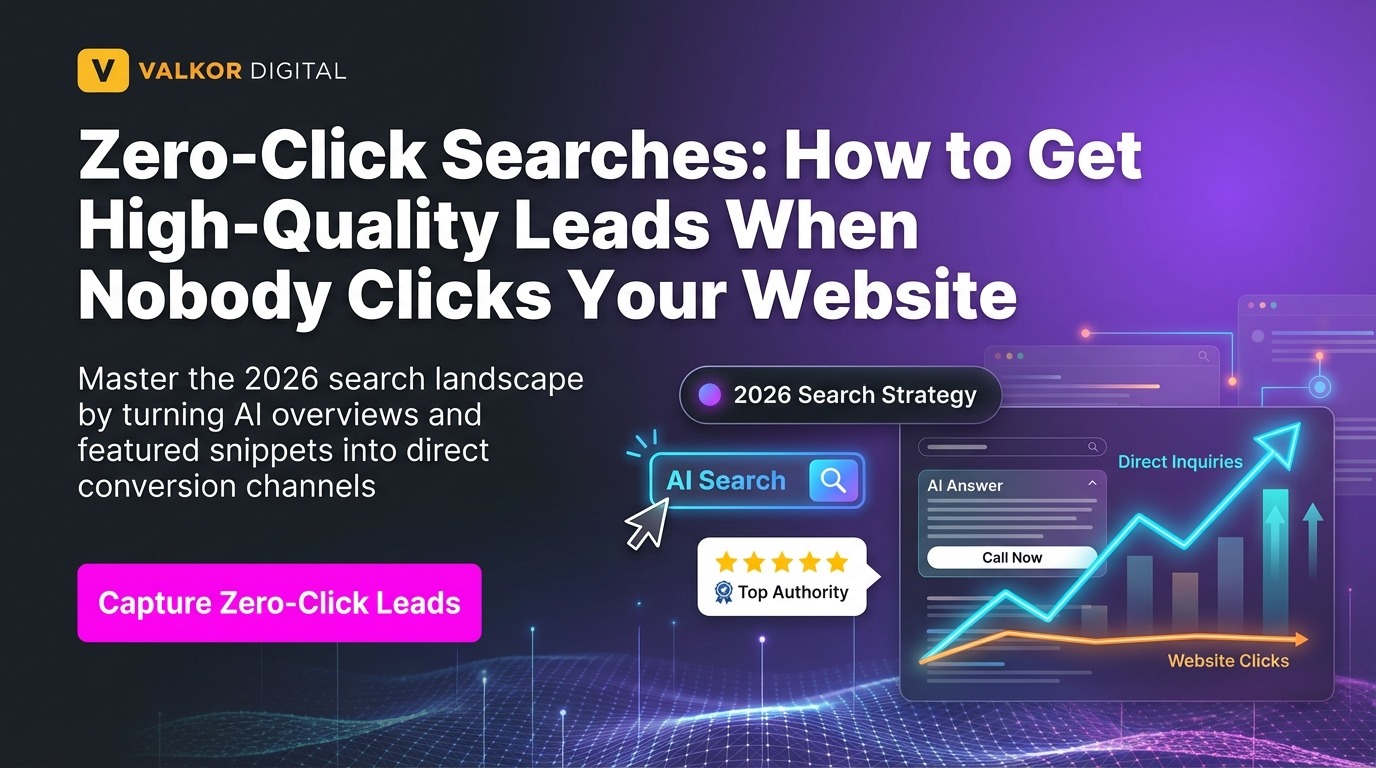
I. The Statistic That’s Keeping Business Owners Up at Night
| Nearly 60% of Google searches in 2026 end without a single click. The user searches. The AI answers. They leave. Your website is never visited. |
If that number made your stomach drop, you are not alone. Across the industry, business owners and marketing managers are watching their organic traffic numbers decline — sometimes dramatically — while their Google rankings stay exactly the same. The rankings did not drop. The clicks did. And for most teams still measuring success by monthly sessions and CTR, the dashboards look like a quiet disaster with no obvious cause.
The cause is structural. Google is no longer purely a search engine that sends traffic to websites. It has become an answer engine — one that increasingly resolves user queries directly on the search results page, with no need for the user to go anywhere else. AI Overviews sit above all organic results. Featured Snippets capture the definitive answer. The Local Map Pack lets users call a business, get directions, and book appointments without loading a single webpage. People Also Ask dropdowns keep users scrolling through answers on Google itself.
The instinctive response from most businesses is panic: ‘SEO is dead. There’s no point.’ That response is wrong — and expensive. The businesses that are winning in this environment are not the ones mourning lost clicks. They are the ones who understood that the battlefield shifted and repositioned accordingly.
This guide is the repositioning playbook. It will show you precisely what zero-click search is, why it is not the catastrophe it appears to be, and — most importantly — four proven strategies for generating real, high-quality leads directly from the search results page, without depending on a click to your website.
II. What Exactly Is a Zero-Click Search in 2026?
A zero-click search occurs when a user’s query is fully satisfied on the search engine results page itself — without the user needing to click any link and visit any website. The SERP has become the destination, not the gateway.
In 2026, multiple Google features contribute to this. Understanding each one is essential because each requires a different optimisation approach:
| SERP Feature | What It Does | How to Appear In It |
| AI Overviews (SGE) | Summarises top answers from multiple sources directly above all organic results. | Get cited: structured content + Schema + E-E-A-T signals. |
| Featured Snippets | Displays a single extracted paragraph or list in a box above organic results. | Answer-first formatting: direct response in the opening 40–50 words. |
| Local Map Pack | Shows 3 local businesses with ratings, hours, phone, and directions. | Complete GBP: reviews, geo-tagged images, weekly posts. |
| People Also Ask (PAA) | Expandable Q&A dropdowns that keep users on the SERP. | FAQ Schema markup + conversational H2/H3 questions in content. |
| Knowledge Panels | Brand information cards that appear for recognisable entities. | Entity optimisation: consistent NAP data, Wikipedia presence, brand mentions. |
The critical insight from this table is that each of these features is not a closed door — it is an alternative stage. You may not get the click, but you can still get the call, the brand memory, the citation, and the conversion. The strategies in Section IV are built around that exact opportunity.
III. The Mindset Shift: Think Like a Billboard, Not a Brochure
Here is the reframe that changes everything: a billboard on the motorway does not get clicked. Nobody pulls over to fill out a contact form at the base of a Gwadar road billboard. But nobody argues that billboards are ineffective marketing.
Zero-click SERP visibility works on the same principle — what marketers call the Billboard Effect. When Google’s AI consistently cites your brand as the answer to questions in your industry, something powerful happens at a psychological level. Users who see your brand named as the authority three, four, five times across different searches begin to associate your business with expertise — even without ever visiting your site.
And then, when they are ready to buy, they do not search generically. They search for you specifically. They type ‘Valkor Digital’ into the search bar, or they say ‘Call Valkor Digital’ to their phone assistant. That is a branded search — and branded searches convert at a dramatically higher rate than any generic keyword traffic because the user has already made up their mind.
| The Deferred Lead Concept A user searching ‘how to improve my website’s conversion rate’ sees your brand cited in an AI Overview. They do not click. They absorb the answer and move on. Two weeks later, when their business partner asks ‘who should we hire for a website redesign?’ — your name surfaces from memory. Not because of a click. Because of repeated SERP presence that built brand authority over time. This is the deferred lead. It is not tracked in Google Analytics. But it is real, it is valuable, and it is the primary conversion mechanism in a zero-click search environment. |
This mindset shift has a practical consequence for how you brief your content team, set KPIs, and evaluate your digital strategy. Stop asking ‘how many clicks did this blog post generate?’ Start asking ‘how many times did our brand appear as the answer to a relevant query this month, and is that number growing?’ Section V of this guide covers exactly how to measure this.
IV. 4 Proven Strategies to Generate Leads from Zero-Click Searches
Each strategy below targets a different zero-click SERP feature. None of them require you to abandon traditional SEO. They layer on top of your existing foundation and activate the parts of Google that are currently generating leads for your competitors.
Strategy 1: Master Google Business Profile — The Ultimate Zero-Click Lead Engine
This is the single highest-ROI zero-click optimisation available to any local business. The Local Map Pack — the three business listings that appear above organic results for location-based queries — is a complete conversion environment. Users can call you, get directions to your office, visit your website, read your reviews, browse your photos, and book an appointment directly from this panel, without ever loading your website. What full GBP optimisation looks like in practice: Weekly GBP Posts: Share updates, new blog links, case study highlights, and service announcements. Frequency signals to Google that your business is active and trustworthy.GBP Q&A Section: Pre-populate your own questions and answers. If you do not do this, anyone can submit questions — including competitors. Write the ten most common questions your clients ask and answer them directly in the Q&A panel.Geo-Tagged Photos: Upload images of your workspace, your team, and your deliverables — with location data embedded. Google uses this to confirm your geographic relevance for local queries.Review Velocity: A steady stream of recent, authentic reviews matters more than a large volume of old ones. Build a systematic, post-project review request into your client offboarding process.Service and Product Listings: Each service you offer should be listed as a discrete GBP service with its own description, category, and pricing indicator where applicable. The goal is to make your GBP so complete that a prospective client can make a fully informed decision — and take a conversion action — without ever leaving Google.
Strategy 2: The Cliffhanger Strategy — Give the What, Gate the How
This is the most nuanced and powerful strategy for turning zero-click visibility into website leads. It requires a specific, deliberate approach to how you structure content — one that is designed to serve both the AI extracting your answer and the human who wants more. The principle: Write your content so that the AI Overview or Featured Snippet receives a clean, complete answer to the surface-level question (the What). But the deeper value — the How, the template, the checklist, the case study, the tool — lives behind a click on your page. A worked example for Valkor Digital: User query: ‘What is a digital marketing strategy?’ AI Overview extracts (the What): Your clean, 50-word definition of a digital marketing strategy — direct, authoritative, citable. Valkor Digital gets cited as the source. The cliffhanger on the page: Immediately following the extracted definition, your page offers: ‘Download our free 2026 Digital Marketing Strategy Template — the exact framework we use for our clients in Karachi and across Pakistan.’ The user must click to access it. They give their email. They are now a lead. Other high-converting cliffhanger assets: A free website speed audit tool or checklist (gated behind an email signup)A downloadable Pakistan-specific local SEO checklistAn interactive calculator (‘How much should your Karachi business spend on digital marketing?’)A case study PDF: ‘How We Grew a Karachi E-commerce Brand’s Revenue by 300% in 6 Months’ The logic is elegant: you give the AI exactly what it needs to cite you as an authority (the What), and you give the high-intent human reader exactly what they need to convert (the How — behind a click that captures their details).
Strategy 3: Dominate Video & Visual Carousels on the SERP
While text-based organic results are being displaced by AI Overviews and Featured Snippets, one SERP real estate category is growing: video and visual carousels. Google prominently features YouTube Shorts, standard YouTube videos, and image carousels above, within, and alongside organic results — and AI cannot yet generate a video to replace yours. This is a structural advantage for businesses willing to invest in even basic video content. You do not need a production studio. A 60 to 90-second video summary of your best blog posts — filmed on a smartphone with clear audio and a branded title card — can appear in SERP video carousels and drive clicks that your written content no longer receives. The content repurposing workflow: Take your top-performing blog post. Identify the single most valuable insight — one that can be explained in 60 seconds.Film a short, direct-to-camera video using that insight as the hook. Use a clear title card with your brand name and the topic keyword.Upload to YouTube with a keyword-rich title, description, and timestamp chapters. Embed the video on the corresponding blog page.Cross-post to Instagram Reels, Facebook, and LinkedIn. Each platform’s algorithm extends the video’s reach — and each one sends additional brand awareness signals to Google’s entity graph. For Valkor Digital specifically: short-form videos covering ‘What is Core Web Vitals?’, ‘How to set up your Google Business Profile in Pakistan’, and ‘Is your website losing leads?’ are all natural, high-search-volume topics that appear in SERP video carousels — and are directly tied to your service offering.
Strategy 4: Implement FAQ Schema — Hijack the ‘People Also Ask’ Boxes
People Also Ask (PAA) dropdowns are among the highest-visibility real estate on any Google results page. They appear on almost every informational query, they are expandable, and they are indexed and updated regularly. Most importantly, they are driven almost entirely by structured data — which means you can engineer your content to appear in them. FAQ Schema Markup is JSON-LD code that you embed in your page’s HTML to declare a structured list of questions and answers. When Google’s crawler detects FAQ Schema on a well-structured, authoritative page, it pulls those Q&A pairs into PAA boxes — putting your brand name, your answer, and a link to your page inside one of the most-clicked elements on the SERP. The implementation checklist: Identify the 8 to 12 questions your potential clients most frequently ask — in the exact conversational phrasing they would use verbally or in a search bar.Write each answer in 40 to 60 words: direct, authoritative, and beginning with the question’s core answer in the very first sentence.Structure these as H3 headings followed by paragraph answers on a dedicated FAQ page or within your service pages.Add FAQ Schema JSON-LD to the page — referencing each question and answer in the structured data block.Validate using Google’s Rich Results Test tool before publishing. A correctly implemented FAQ Schema page that passes validation can appear in PAA boxes within days of indexing. The PAA box displays your brand name and a link even when no click happens. Every time a user expands your PAA answer, your brand is presented as the authority. This is zero-click visibility that actively builds brand recognition — and occasionally drives the click through to your page when the user wants the deeper context.
V. How to Measure SEO Success in a Zero-Click World
The biggest obstacle most businesses face in adapting to zero-click search is not strategic — it is measurement. When your reporting dashboard still shows organic traffic and CTR as the primary success metrics, everything about zero-click optimisation looks like failure. You need to retire the old metrics and replace them with KPIs that reflect the actual value being generated.
The table below gives you the exact translation from legacy SEO reporting to 2026 zero-click measurement:
| Outdated Metric (Pre-2025) | New Zero-Click KPI (2026+) | What It Actually Tells You |
| Total Organic Traffic | Total Search Impressions | How often your brand appears on the SERP — even when no click happens. Impressions build the Billboard Effect. |
| Click-Through Rate (CTR) | On-SERP Conversions | Direct calls, WhatsApp messages, map directions, and appointment bookings made straight from your Google Business Profile. |
| Rank Position (1–10) | Featured Snippet Ownership | The percentage of industry questions in your niche where Google cites your brand as the definitive answer. |
| General Keyword Volume | Branded Search Volume | Month-over-month growth in users searching your company name directly — the clearest signal the Billboard Effect is working. |
| Bounce Rate | SERP Engagement Rate | How often users interact with your GBP, click your FAQ dropdowns, or watch your video results — all without leaving Google. |
Implementing this new measurement framework requires a few practical changes. Google Search Console’s Performance report gives you impressions data. Google Business Profile Insights gives you on-SERP conversion tracking (calls, direction requests, website clicks). Google Analytics 4’s acquisition reports show branded vs. non-branded search splits — watch the branded search line month over month. That number is your Billboard Effect score.
| The Single Most Important Number to Track in 2026 Branded search volume growth. If the number of people searching for your company name specifically — ‘Valkor Digital’, not just ‘web agency Karachi’ — is growing month over month, your zero-click strategy is working. The SERP visibility is converting into brand memory, and brand memory is converting into purchase intent. No dashboard plugin required. It is visible directly in Google Search Console under the Queries filter. |
VI. Conclusion: Stop Fighting Zero-Click. Start Engineering It.
The businesses that are losing in 2026’s search environment are not losing because zero-click searches exist. They are losing because they are still trying to fight the shift instead of engineering their presence around it.
Complaining that Google keeps users on the SERP is like a shop owner complaining that a shopping mall has comfortable seating — the environment changed, and the customers adapted to it. The question is not how to reverse that. The question is how to be the most visible, most credible, most actionable presence inside that environment.
The four strategies in this guide — a fully optimised Google Business Profile, the Cliffhanger content approach, video SERP assets, and FAQ Schema implementation — are not theoretical. They are the specific mechanisms by which brands are generating calls, leads, and branded search volume from a search landscape where fewer than half of queries result in a click.
The adaptation is not complicated. But it requires deliberate execution. And it rewards the businesses that start now, before their competitors do.
Valkor Digital doesn’t chase vanity traffic.
We engineer digital dominance — optimising your entire web presence to capture leads whether they click your website or not. GBP, Schema, Video, Content Architecture: all under one roof.
→ Get a Free Zero-Click SEO Audit for Your Brand ←
What’s Next? You now have the blueprint to capture leads directly from the search engine results page. But here is the final piece of the puzzle: How does Google’s AI decide that your brand deserves to be the featured answer instead of your competitor?
It all comes down to a framework called E-E-A-T (Experience, Expertise, Authoritativeness, and Trustworthiness). Without it, AI engines will ignore your website completely.
👉 Learn how to build an unbreakable digital reputation: Why E-E-A-T is Your Best Defense Against AI in 2026.