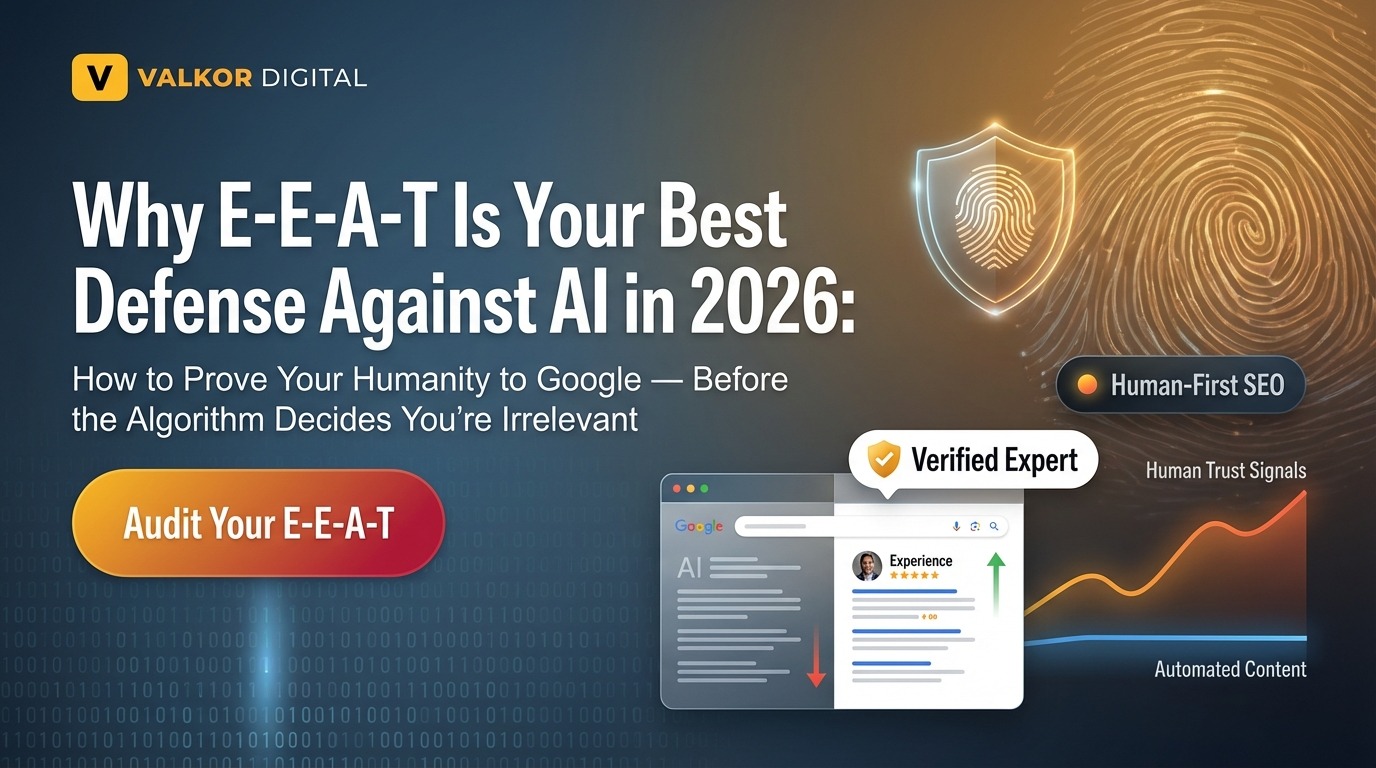
How to Prove Your Humanity to Google — Before the Algorithm Decides You’re Irrelevant
I. The Content Flood — and the Algorithm Built to Filter It
When ChatGPT launched in late 2022, a large portion of the business world had the same thought simultaneously: content just got free. Within eighteen months, billions of words of AI-generated blog posts, service page copy, and SEO articles were published across the internet. Marketing teams cut their content budgets. Agencies automated their output. The SEO industry braced for an era of effortless productivity.
What actually happened was the opposite of effortless. The internet became saturated with content that was structurally correct, grammatically clean, topically relevant — and completely indistinguishable. Every article about digital marketing strategy said the same things in the same order using the same phrases. Every guide to local SEO repeated the same five tips that had been recycled since 2019. The signal-to-noise ratio in search collapsed.
Google’s response was systematic and deliberate. The Helpful Content system — already in place — was retrained and expanded. Spam detection was refined to identify patterns common to mass-produced content. Quality rater guidelines were updated to place increasing weight on a concept that had existed in Google’s framework for years but suddenly became the primary filter separating the cited from the buried: E-E-A-T.
| The core problem in plain language: If your website looks, sounds, and reads like a robot wrote it — your traffic will flatline. Not because your SEO is technically broken. Because Google’s AI is now sophisticated enough to recognise the difference between content that comes from genuine human expertise and content that comes from a language model filling a content calendar. |
E-E-A-T — Experience, Expertise, Authoritativeness, and Trustworthiness — is the framework Google uses to evaluate whether a piece of content was produced by someone who genuinely knows what they are talking about, or whether it was manufactured at scale to capture search traffic. In 2026, it is the single most important concept in content strategy. And for Pakistani businesses willing to invest in it properly, it is also a significant competitive advantage over the generic, AI-flooded landscape.
II. Decoding E-E-A-T in the AI Era
E-E-A-T is not a ranking factor in the direct technical sense — there is no score you can check in Search Console. It is a quality framework that Google’s systems and human quality raters use to evaluate whether content meets the standard of being genuinely helpful, accurate, and produced by a credible source. In the AI era, the bar has moved significantly higher because the alternative — generic AI content — is now the default, not the exception.
Each letter carries specific implications for how you build and present your content in 2026:
| E Experience The newest and most decisive factor. Experience means firsthand, real-world interaction with the subject being discussed. An AI can summarise 1,000 articles about launching a Shopify store in Pakistan. It cannot describe the specific payment gateway issues it personally solved for a Karachi retailer in Q3 2025. That human, lived specificity is irreplaceable — and Google’s quality raters are explicitly trained to look for it. | E Expertise Does the author have demonstrable credentials in this field? Expertise is proven through verifiable qualifications, years of active practice, and the depth and accuracy of what is written. A certified developer writing about Shopify performance carries expertise signals. An anonymous ‘content team’ writing the same article does not — regardless of how well the prose is structured. | |
| A Authoritativeness Authority is what other people say about you, not what you say about yourself. It is built through third-party mentions — citations in industry publications, backlinks from authoritative domains, being referenced in relevant forum discussions on Reddit and Quora, and being named in digital PR. Authority cannot be manufactured on your own site. It must be earned externally. | T Trustworthiness The foundation that the other three letters rest on. Trust is both technical and human: HTTPS and site security, transparent privacy policies, real contact details (not a generic form), named authors with verifiable identities, genuine customer reviews, and a consistent track record of accurate information. A site with strong Experience, Expertise, and Authority but weak Trust signals still gets filtered. | |
The most important tactical insight from this breakdown: the first E — Experience — is the one that AI content structurally cannot fake. An LLM can approximate expertise through pattern matching. It can approximate authority by citing known sources. It can approximate trustworthiness by following safe, hedged language patterns. But it cannot describe what it personally experienced, because it has experienced nothing. That gap is your competitive moat.
III. AI-Generated Fluff vs. High E-E-A-T Content: The Comparison
The distinction between low-E-E-A-T and high-E-E-A-T content is not always obvious to the human eye on first reading. Generic AI content is often grammatically impeccable and correctly structured. The difference shows in the specificity, the originality, the verifiability, and the genuine utility of what is written. The table below maps the key dimensions Google’s quality systems evaluate:
| Dimension | Generic AI Content | High E-E-A-T Content |
| Data & Statistics | Cites outdated figures or, worse, fabricates statistics that sound plausible but cannot be verified. No primary sources. | Uses original research, internal client data, current case studies, and citations from verifiable 2025–2026 sources. |
| Author Profile | ‘By Admin’ or no author listed. No bio, no credentials, no professional presence that a reader could verify. | Written by a named expert with a detailed bio, years of active experience, linked credentials, and a live LinkedIn profile. |
| Tone & Style | Robotic cadence, repetitive sentence structures, generic vocabulary, excessive use of phrases like ‘In today’s fast-paced world.’ | Conversational, opinionated, and occasionally contrarian. Reads like a practitioner who has strong views formed by real work. |
| Value Added | Summarises what already exists on the internet. Adds no new perspective, framework, data, or insight. | Introduces proprietary frameworks, unique local case studies, original data, or a contrarian take the reader has not seen elsewhere. |
| Specificity | Generic advice applicable to any country, industry, or business type. Could have been written about anyone. | Hyper-specific: references local market conditions, specific Pakistani platforms, real client sectors, and named city contexts. |
| AI Overview Result | Filtered out or penalised. Google’s quality systems increasingly detect and downweight mass-produced content at scale. | Cited as the primary, trusted source. The author and brand are named in the AI’s answer, driving both visibility and authority. |
The actionable conclusion from this table is straightforward: every piece of content your brand publishes should fail to be reproducible by a generic AI prompt. If an AI could write your article just as well as your team did — with the same data, the same examples, the same perspective — then that article has no E-E-A-T advantage. The uniqueness must be structural, not cosmetic.
IV. 4 Actionable Steps to Build Bulletproof E-E-A-T
E-E-A-T is not a content style — it is an infrastructure. It requires deliberate, systematic changes to how you publish, how you structure your site, how you build your off-page presence, and how you represent your people. The following four steps are the highest-leverage moves available to any Pakistani business starting this process in 2026.
Step 1: Build Detailed, Verified Author Bios
Stop publishing content under ‘Valkor Team,’ ‘Admin,’ or no author attribution at all. This single practice is one of the clearest signals to Google’s quality systems that content was produced without individual human accountability and it directly undermines your Expertise and Experience signals.
Every article published on your website needs a named author with a dedicated author bio page. For Valkor Digital, this means that Ali Abbass Memon or whichever team member authored the piece has a publicly accessible author page containing: Full name and professional title (e.g., Founder & Digital Strategist, Valkor Digital)Years of active experience in the specific field being written about Verifiable credentials: certifications, education, or industry recognitionLinks to active professional profiles: LinkedIn, Twitter/X, or a personal portfolio A list of other articles and case studies written by this author on the site The author bio page functions as a trust anchor for every article linked to it. When Google’s crawler follows an article byline to a fully populated, verifiable author page with consistent cross-platform presence, the Experience and Expertise signals are materially strengthened for every piece that author publishes — including articles indexed before the bio page existed.
Step 2: Implement ‘Organisation’ & ‘Person’ Schema Markup
Schema Markup is the technical mechanism by which you feed your brand’s credentials directly into Google’s AI in a format the machine can parse, trust, and use to build its understanding of your entity. Without it, Google is left inferring your identity and authority from context. With it, you are declaring it explicitly.
For E-E-A-T specifically, two Schema types are essential: Organisation Schema: Declares your business name, legal registration, founding date, physical address, contact information, and official social media profiles. This establishes your brand as a verified, real-world entity — the baseline for Trustworthiness.
Person Schema: Applied to author pages, this Schema declares the individual’s name, job title, organisation affiliation, and credentials. When a Person Schema entity is consistently associated with high-quality articles on your site, the individual’s authority begins to transfer to the site as a whole.
The practical result: When an AI Overview references content from your site, it sometimes names the author and brand as part of the citation — ‘According to Ali Abbass Memon at Valkor Digital…’ This named citation is the highest-value E-E-A-T outcome in the zero-click search environment. It builds both the Billboard Effect and the brand trust signal in a single appearance. Schema Markup is invisible to readers but one of the highest-signal inputs available to Google’s entity understanding systems. Implementing it correctly is a technical task — but it is a one-time infrastructure investment that pays compounding dividends as your content library grows.
Step 3: Publish Original Case Studies — Your Irreplaceable Asset
Here is the single most powerful content type available to any service business in 2026: the proprietary case study. An AI cannot invent the specific results your team achieved for a specific client in a specific Pakistani city during a specific time period. That data exists only inside your business — and publishing it is, structurally, the most defensible E-E-A-T content you can produce.
A high-E-E-A-T case study for Valkor Digital is not a vague testimonial page. It is a documented, data-rich account of a real engagement: the client’s initial situation, the specific strategy deployed, the measurable outcomes achieved, and the lessons learned. It names the client (with permission), names the Valkor team members involved, cites specific performance data — traffic growth percentages, lead volume changes, revenue impact — and links to verifiable evidence where possible.
What makes a case study an E-E-A-T powerhouse: It demonstrates Experience: a real project, real decisions, real challenges encountered.It demonstrates Expertise: the specific techniques, tools, and strategic frameworks applied.
It builds Authority: when cited in other publications or referenced in industry discussions, it creates off-page endorsement of your capabilities.It builds Trust: specific numbers, named clients, and verifiable timelines are the antithesis of vague AI-generated claims. Aim for one detailed case study per quarter at minimum. Each one becomes a permanent asset — linkable, citable, rankable, and completely immune to AI replication because the data inside it belongs only to you.
Step 4: Cultivate Off-Page Trust Through Digital PR
E-E-A-T is not determined solely by what is on your website. Authority and Trustworthiness are primarily signals that come from outside your domain — from the broader web’s assessment of your credibility. This is why off-page trust building is a non-negotiable component of any serious E-E-A-T strategy in 2026.
The highest-value off-page trust signals for a Pakistani digital agency: Industry publication features: A bylined article in ProPakistani, TechJuice, or Dawn Business carries enormous Authority weight. It signals that a credible third-party editor validated your expertise and chose to publish it under your name.
Reddit and forum citations: When genuine community members reference your content or recommend your agency in relevant Pakistani business forums and subreddits, AI models interpret this as authentic, unsponsored endorsement.
LinkedIn founder content: Ali Abbass publishing substantive professional insights on LinkedIn — not just post-and-run promotional content, but genuine perspective pieces that generate engagement and comments — directly builds the Person entity signal associated with Valkor Digital.
Clutch and Google Business Profile reviews: Verified reviews from named, real clients on recognised platforms are among the strongest Trustworthiness signals available. They are the digital equivalent of a reference check — and AI models treat them accordingly.
Expert quotes and podcast appearances: Being quoted as an expert source by another publication — even a small but reputable one — creates a third-party credibility signal that your own website cannot generate for itself. Off-page E-E-A-T cannot be rushed. But it can be systematically built — one byline, one review, one thoughtful LinkedIn post at a time. The compounding effect over six to twelve months is substantial, and the competitive advantage it creates is very difficult for newer or less committed competitors to close.
V. The Local Edge: Why Pakistani Businesses Have an E-E-A-T Advantage
The Hyper-Local Context That AI Cannot Replicate
AI language models are trained primarily on English-language, Western-market content. They are reasonably good at general digital marketing advice. They are significantly weaker at hyper-local Pakistani context: the specific dynamics of FBR compliance for e-commerce businesses, the payment gateway landscape (JazzCash, Easypaisa, Stripe limitations), the buying habits of Karachi’s DHA market versus Lahore’s Gulberg corridor, or the seasonal impact of Eid shopping cycles on local digital campaigns.
A Pakistani digital agency that writes from genuine, lived experience of this market — with specific data, named platforms, real regulatory context, and authentic client examples from local sectors — is producing content that no generic AI can replicate. That specificity is E-E-A-T in its most powerful form: not just accurate, but irreplaceable.
When you publish an article titled ‘How Pakistani E-commerce Businesses Can Optimise for Ramadan Search Behaviour’ — with real campaign data from your own client work — you are creating content that serves a search query that millions of tools are not competing for, with a depth of experience that cannot be scraped or synthesised. That is the local edge.
Local Reviews Are Your Strongest Trust Signal
For Pakistani businesses specifically, verified Google Business Profile reviews from real clients in Karachi, Lahore, Islamabad, and other major cities carry disproportionate Trust weight. They are geographically specific, identity-verified, and timestamped — the combination of signals that Google’s quality systems treat as high-confidence Trustworthiness evidence.
A systematic review generation process — built into every client offboarding, every project handover, every successful campaign completion — is not just good customer service practice. It is a deliberate E-E-A-T infrastructure investment that accumulates compounding value with every new review added.
| The E-E-A-T opportunity for Pakistani businesses in plain terms: Your international competitors know more about global SEO than you do. But they know almost nothing about your specific market. Your local competitors have market knowledge but have not structured it as publishable authority content. The window to own the E-E-A-T high ground in Pakistan’s digital marketing niche is open right now — and it will not stay open indefinitely. The business that publishes first, publishes specifically, and publishes consistently from genuine expertise will own the AI citations, the branded searches, and the market authority that follows. |
VI. Conclusion: AI Is the Flood. E-E-A-T Is the Levee.
The businesses that panicked about AI-generated content — and responded by producing more of it — accelerated their own decline. They fed the flood. The businesses that are winning now are the ones that recognised the paradox: the best defense against a world drowning in AI-generated content is relentlessly, systematically human content.
Experience that is first-hand. Expertise that is verifiable. Authority that is earned externally. Trust that is built technically, behaviourally, and through genuine client relationships. None of those things can be automated. All of them compound over time into a position that is genuinely difficult for any competitor — human or artificial — to displace.
Building bulletproof E-E-A-T takes time, strategic consistency, and technical execution across your website, your content, and your off-page presence. It is not a campaign. It is a foundation. But it is the only foundation that remains stable in a search landscape that will continue to shift beneath every business that fails to build it.
| Missed the beginning of this series? Traditional SEO vs. GEO in 2026: Why Your Rankings Are Fine But Your Traffic Is Dying Start from the beginning of Valkor Digital’s AI Search Dominance series to see how E-E-A-T, GEO, Local SEO, and Zero-Click strategy all connect into a single, unified digital authority system. |
At Valkor Digital, we don’t just write blogs.
We build digital empires based on undeniable authority — with the technical Schema infrastructure, the content architecture, and the off-page trust building that makes AI cite your brand over your competitors.
→ Schedule a Strategy Call to Build Your Brand’s Authority Today ←