Expanding your business into international markets creates new opportunities to reach customers, build brand awareness, and increase organic traffic. However, before targeting audiences in multiple countries, you need to decide how to structure your website for different markets.
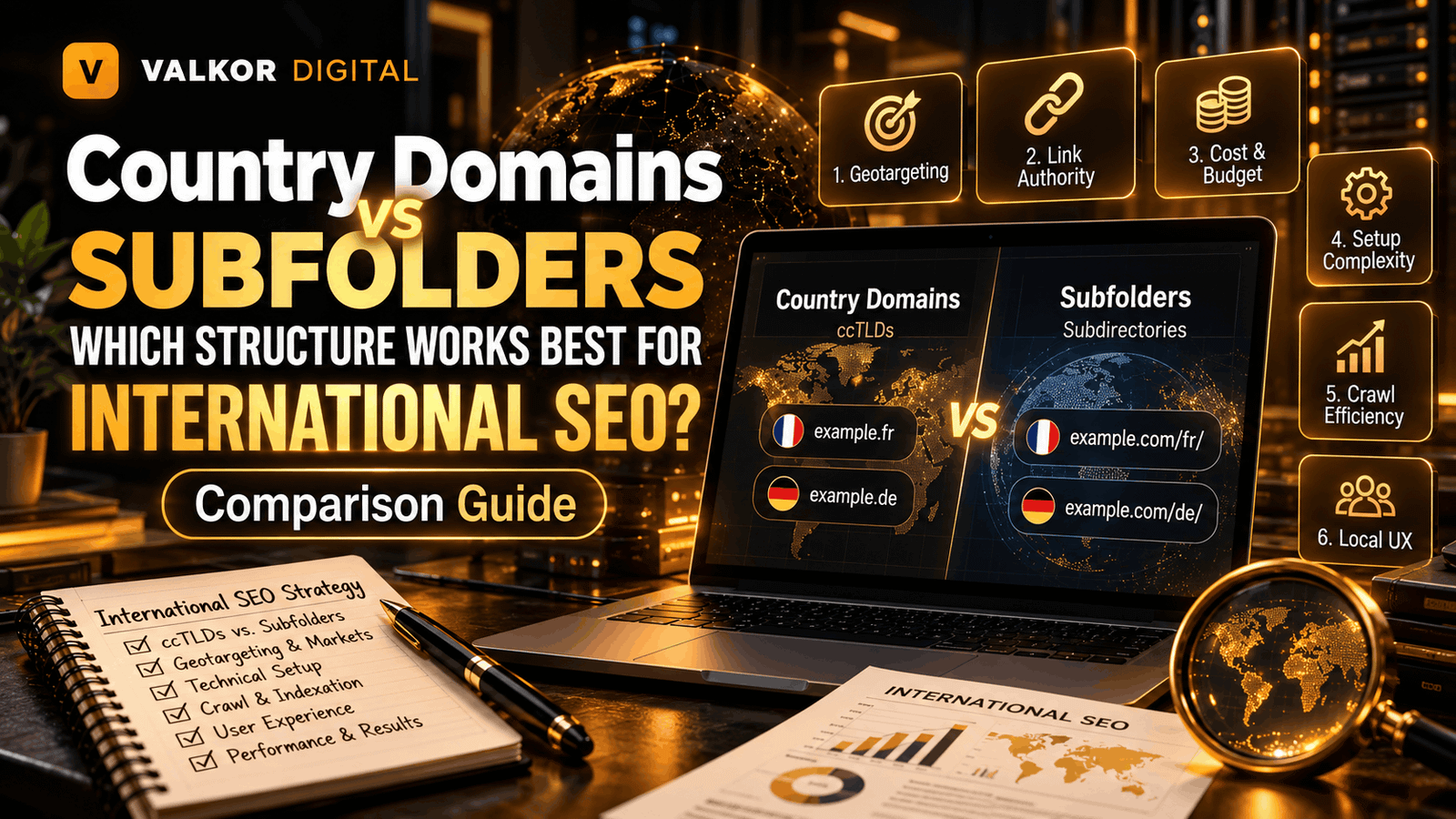
Two common options are country-specific domains and subfolders. For example, a business might use example.fr for France or example.com/fr/ for French-language content on its main domain.
Both approaches can support international SEO, but they have different advantages, costs, and management requirements. Choosing the right international website structure depends on your business goals, target countries, resources, and plans for future expansion.
In this guide, we compare country domains vs subfolders, explain their SEO implications, and help you choose the structure that best fits your international growth strategy.
What Is an International Website Structure?
An international website structure determines how your website organizes content for different countries or language audiences.
For example, a company operating in the United States, the United Kingdom, and France might create separate versions of its website for each market.
There are several ways to organize these versions:
- Country-specific domains:
example.fr - Subfolders:
example.com/fr/ - Subdomains:
fr.example.com - Language-based subfolders:
example.com/fr/for French-language content, regardless of the reader’s country
The best option depends on whether you are targeting specific countries, language groups, or both.
A clear website structure helps businesses organize localized content and manage international SEO more effectively.
What Are Country-Specific Domains?
Country-specific domains, also known as country-code top-level domains (ccTLDs), use domain extensions associated with particular countries or territories.
Examples include:
example.frfor Franceexample.defor Germanyexample.co.ukfor the United Kingdom
A ccTLD can provide a clear country-specific signal and may help visitors recognize that a website is intended for their market.
Benefits of Country-Specific Domains
1. Clear country targeting
A country-specific domain sends a strong signal about the intended geographic market. Users may also feel more confident when the domain reflects their country.
2. Local brand identity
Separate country domains can help businesses establish distinct local identities, especially when pricing, products, regulations, or customer expectations differ significantly between markets.
3. Greater market flexibility
Businesses can manage separate websites when local teams need considerable independence over content, promotions, products, and customer experiences.
Disadvantages of Country-Specific Domains
1. Higher management costs
Operating several domains can require additional hosting, development, maintenance, analytics configuration, and technical support.
2. Separate SEO efforts
Each domain needs its own SEO management. Links and authority signals are not automatically consolidated across separate domains, so building visibility in every market may require additional effort.
3. More complex maintenance
Businesses must coordinate redirects, security, tracking, content updates, and technical changes across multiple websites.
Country-specific domains can work well for companies with substantial resources and genuinely different market requirements. However, they may be unnecessarily complex for smaller businesses entering international markets for the first time.
What Are Subfolders in International SEO?
Subfolders, sometimes called subdirectories, organize country- or language-specific content under the same main domain.
For example:
example.com/fr/for French contentexample.com/de/for German contentexample.com/es/for Spanish content
The main domain remains consistent, while each market or language has its own directory.
Benefits of Subfolders
1. Simpler website management
A single domain can make it easier to manage website content, technical settings, analytics, and SEO activities.
2. Consolidated domain signals
Pages remain part of the same domain, allowing internal links and external links to support the wider website. This does not guarantee rankings, but it can simplify domain-level SEO management.
3. Easier expansion
Adding a new country or language can be as straightforward as creating a new directory and publishing appropriately localized content.
4. More centralized reporting
A shared domain can make it easier to compare market performance through analytics and search reporting, provided tracking is configured correctly.
Disadvantages of Subfolders
1. Less obvious country identity
A subfolder does not communicate country targeting as explicitly as a country-specific domain. Its meaning may depend on the folder name, content, and other signals.
2. Shared technical dependencies
Different market versions may rely on the same CMS, templates, plugins, and technical infrastructure. A poorly managed update can affect multiple markets.
3. Potentially less local independence
Companies with separate regional teams may find a shared website harder to manage if every market requires substantially different branding, functionality, or business operations.
For many businesses, subfolders offer a practical balance between international expansion and manageable SEO operations.
Country Domains vs Subfolders: Key Differences
| Factor | Country-specific domains | Subfolders |
|---|---|---|
| Example | example.fr | example.com/fr/ |
| Country targeting | Strong country-specific signal | Requires supporting signals |
| Management | More complex across domains | More centralized |
| Expansion costs | Often higher | Often lower |
| SEO management | Separate domain-level efforts | Centralized domain structure |
| Local branding | Strong market identity | Consistent global brand |
| Best suited for | Distinct country operations | Businesses managing multiple markets centrally |
Neither structure guarantees better rankings. Search engines consider multiple signals, including content relevance, language, links, technical accessibility, and the intended audience.
Which Website Structure Is Better for International SEO?
There is no single structure that works best for every business. The right choice depends on how your company operates and how much localization each market requires.
Choose Country Domains If:
- Your business has established operations in individual countries.
- Local branding is a major priority.
- Products, prices, services, or regulations vary considerably by market.
- Regional teams need substantial control over their websites.
- You have enough resources to manage separate domains effectively.
For example, a large retailer with different product catalogs and business operations in France and Germany may benefit from dedicated country domains.
Choose Subfolders If:
- You want to expand internationally without managing many domains.
- Your brand and core services remain consistent across markets.
- Your website is managed by one central team.
- You want to simplify content management and technical maintenance.
- You need a structure that can grow as you add languages or countries.
For example, a consulting company that offers similar services internationally might use example.com/fr/ and example.com/de/ to organize localized content under one main domain.
For many small and medium-sized businesses, subfolders are a practical starting point because they are relatively straightforward to manage. However, the final decision should reflect business requirements rather than SEO assumptions alone.
What About Subdomains?
Subdomains are another option for organizing international content.
For example:
fr.example.comde.example.comes.example.com
They can be useful when different markets require separate technical environments or when teams need greater independence.
However, subdomains introduce additional configuration and management considerations. Their SEO performance depends on the overall implementation and content quality, not simply the fact that a subdomain exists.
Choose subdomains when they solve a real organizational or technical need rather than using them automatically for every new market.
International SEO Best Practices for Any Website Structure
Whichever structure you choose, follow these important practices.
1. Use Hreflang Tags Correctly
Hreflang annotations help search engines understand the relationship between localized or language-specific versions of a page.
For example, a page available in English for the United States and English for the United Kingdom may need separate language-region annotations when both versions genuinely exist.
Ensure that hreflang values are valid, alternate URLs are accessible, and the annotations are implemented consistently. Avoid assigning country-specific hreflang values to pages that do not actually serve those audiences.
2. Create Useful Localized Content
Do not simply translate every page word for word and assume the result is appropriate for every market.
Consider local search behavior, terminology, spelling, currencies, cultural expectations, and customer needs. Content should help the intended audience rather than exist only to create another country version.
3. Use Clear URL Structures
Choose a consistent URL pattern and apply it across the website.
Avoid mixing country domains, subdomains, and subfolders without a clear reason. A consistent structure makes content planning, maintenance, and reporting easier.
4. Review Canonical Tags and Indexing
Each localized page should have an appropriate canonical configuration. Do not automatically canonicalize all international versions to one global page if those pages are intended to serve different audiences.
Make sure important localized URLs can be crawled and indexed, and avoid accidental duplication caused by parameters or inconsistent URL versions.
5. Monitor Each Market Separately
Use Google Search Console and analytics tools to assess performance across countries and language versions.
Review impressions, clicks, landing pages, conversions, and technical issues. These insights can help you determine whether a market needs better localization, improved content, or technical corrections.
For a broader international strategy, explore Valkor Digital’s international SEO services, which can support planning for multi-market website visibility.
Common Mistakes to Avoid
When planning an international website structure, avoid these common errors:
- Choosing country domains solely because they appear more SEO-friendly.
- Assuming subfolders automatically rank better than separate domains.
- Publishing translated pages without meaningful localization.
- Implementing hreflang tags without checking the corresponding URLs.
- Changing existing URLs without a proper redirect plan.
- Creating country pages with nearly identical content and no clear audience benefit.
- Failing to monitor performance in each target market.
A successful international SEO strategy requires more than choosing a URL format. It needs a clear market plan, appropriate content, reliable technical implementation, and ongoing evaluation.
Frequently Asked Questions
1. Are country-specific domains better for international SEO?
Country-specific domains provide a strong geographic signal and can support local branding. However, they are not automatically better for rankings. The best choice depends on your target markets, resources, and website strategy.
2. Are subfolders good for international SEO?
Yes. Subfolders can be an effective way to organize international content under one main domain. They often simplify website management and make it easier to expand into additional markets.
3. What is the difference between a ccTLD and a subfolder?
A ccTLD is a country-specific domain, such as example.fr. A subfolder is a directory within an existing domain, such as example.com/fr/. Both can be used for international websites, but they differ in geographic signals and management requirements.
4. Do subfolders share domain authority?
Subfolders exist within the same domain, so pages can benefit from a connected internal linking structure and the site’s broader link profile. However, rankings are not automatically transferred or guaranteed; individual pages still need relevant, useful content and sound technical implementation.
5. Should I use subdomains or subfolders for different languages?
Subfolders are often a simpler starting point when you manage all language versions centrally. Subdomains may be suitable when different markets need separate technical environments or independent management. The choice should match your operational needs.
6. Do I need hreflang tags if I use country-specific domains?
Hreflang can still be useful when you have equivalent pages for different language or regional audiences, even if those pages use separate domains. It helps search engines understand the relationship between the versions.
7. Can I change from country domains to subfolders later?
Yes, but a migration needs careful planning. You should map old URLs to their corresponding new URLs, implement appropriate permanent redirects, update internal links and hreflang annotations, review canonical tags, and monitor indexing and traffic after launch.
Final Thoughts
Choosing between country-specific domains and subfolders is an important decision for businesses planning international growth. Country domains can support a strong local identity, while subfolders often offer a simpler way to manage multiple markets under one main domain.
Before deciding, evaluate your target countries, localization requirements, available resources, technical setup, and long-term plans. Then use a consistent URL structure, accurate hreflang implementation, localized content, and ongoing performance monitoring to support your international SEO strategy.
The best international website structure is the one that supports your business goals while remaining technically reliable and manageable as you grow.