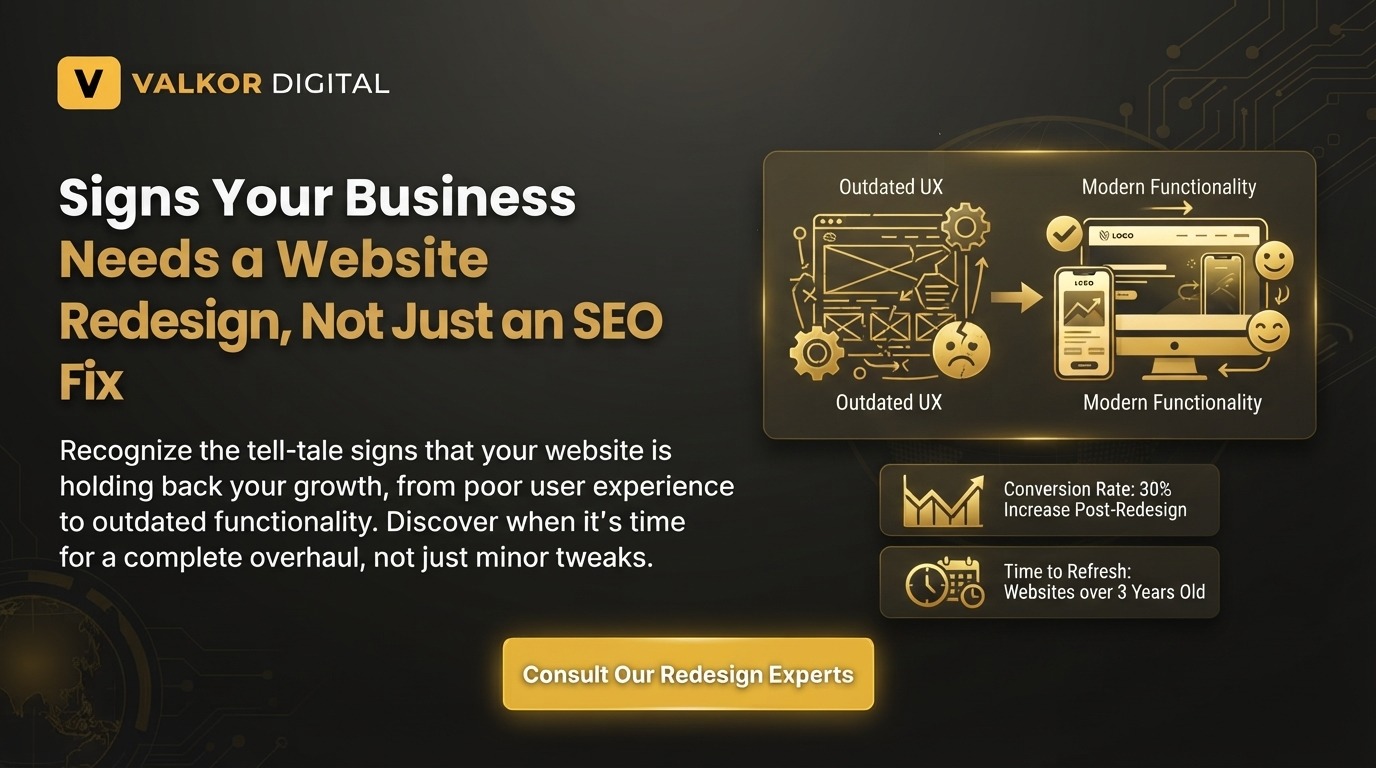
Many business owners assume that a drop in website traffic or rankings automatically means they need a new SEO strategy. However, in a large number of cases, the real problem lies far deeper than keywords or backlinks. If your website suffers from structural, technical, or design-related issues, no amount of SEO work will produce lasting results. Recognizing the signs you need a website redesign early can save your business from wasted marketing spend and missed opportunities.
This article breaks down the most common outdated website problems, explains how UX and conversions are connected, and provides a practical website redesign checklist to help you decide your next move.
Why SEO Alone Sometimes Isn’t Enough
SEO is designed to improve visibility, not to fix a broken user experience. If people are landing on your site but leaving quickly, or if your design looks outdated compared to competitors, SEO efforts will only bring more visitors to a website that cannot convert them. This is one of the clearest signs you need a website redesign rather than another round of keyword optimization.
A website redesign addresses the foundation—structure, usability, speed, and visual credibility—while SEO builds on top of that foundation. Without a solid base, SEO results tend to plateau or decline over time, regardless of how much content or backlinking effort is applied.
Common Outdated Website Problems That Signal a Redesign

Before investing further in SEO, it’s important to evaluate whether your website is suffering from deeper, structural issues.
1. Inconsistent or Dated Visual Design
If your website still uses design trends from five or more years ago—small fonts, cluttered layouts, or outdated color schemes—visitors may question your business’s credibility. First impressions matter, and outdated visuals often drive potential customers straight to competitors.
2. Poor Mobile Responsiveness
With most web traffic now coming from mobile devices, a site that doesn’t adapt properly to different screen sizes creates a frustrating experience. If your navigation menu breaks, images overflow, or buttons are too small to tap, this is a strong signal that redesign—not SEO—is the priority.
3. Slow Loading Speeds
Even well-optimized content won’t perform if your website takes too long to load. Slow speeds are often caused by outdated code, heavy unoptimized images, or an aging content management system. These are core outdated website problems that SEO cannot resolve on its own.
4. Confusing Site Navigation
If users struggle to find information, contact forms, or product pages, they are likely to leave your site quickly. A confusing structure not only frustrates visitors but also makes it harder for search engines to properly index your pages.
How UX and Conversions Are Directly Connected
One of the most overlooked aspects of website performance is the relationship between UX and conversions. Search engines increasingly reward websites that provide smooth, intuitive user experiences. If your bounce rate is high and time-on-page is low, this often reflects usability issues rather than a lack of relevant content.
Clear Calls-to-Action (CTAs)
Outdated websites frequently bury CTAs beneath excessive text or place them in hard-to-notice locations. Redesigning your layout to feature clear, strategically placed CTAs can significantly improve conversion rates.
Simplified User Journeys
A well-structured website guides visitors naturally toward a decision—whether that’s making a purchase, filling out a form, or booking a consultation. If your current layout creates unnecessary steps or friction, it directly harms both UX and conversions.
Trust Signals and Modern Design Elements
Modern design elements such as testimonials, certifications, and professional imagery help build trust. Older websites often lack these elements, making them appear less credible compared to newer competitors.
Website Redesign Checklist: Key Areas to Evaluate
To determine whether your business needs a redesign, review this practical website redesign checklist:
Technical Health
- Page loading speed under three seconds
- Mobile responsiveness across all devices
- Secure HTTPS protocol
- Clean, error-free code structure
Design and Branding
- Modern, professional visual design
- Consistent branding across all pages
- Clear typography and readable content layout
User Experience
- Intuitive navigation menu
- Logical site structure and internal linking
- Fast-loading, distraction-free pages
Conversion Optimization
- Clear, visible calls-to-action
- Simplified contact and checkout processes
- Strategically placed trust signals
If your website fails several of these checklist items, this is one of the clearest indications that a redesign should take priority over further SEO investment.
When SEO Fixes Are Simply Not Enough
There are situations where SEO can genuinely help—such as improving content relevance or fixing metadata issues. However, when the underlying website structure is outdated, no SEO strategy can compensate for a poor user experience. This is why identifying the signs you need a website redesign early is critical to protecting both your search rankings and your conversion rates.
Instead of continuously investing in surface-level SEO fixes, many businesses find far greater long-term value in professional website redesign services that address design, functionality, and performance simultaneously.
Final Thoughts
A website redesign is not simply a cosmetic upgrade—it is a strategic investment in your business’s digital presence. By recognizing outdated website problems, understanding the connection between UX and conversions, and following a structured website redesign checklist, you can make an informed decision about your next steps.
If your website continues to underperform despite ongoing SEO efforts, it may be time to look beyond SEO and consider a full redesign to future-proof your online presence.
Frequently Asked Questions
1. How do I know if I need a website redesign or just an SEO update?
If your website has slow loading speeds, poor mobile responsiveness, or confusing navigation, these are structural issues that SEO cannot fix. A redesign is usually needed when the problem lies in design or usability rather than content visibility.
2. How often should a business redesign its website?
Most businesses should consider a redesign every two to three years, or sooner if design trends, technology, or user expectations have significantly changed.
3. Does a website redesign improve SEO rankings?
Yes, a well-executed redesign can improve SEO performance by enhancing site speed, mobile usability, and overall user experience—factors that search engines consider important.
4. What is the biggest sign that a website looks outdated?
Cluttered layouts, small unresponsive text, and inconsistent branding are among the most common indicators of an outdated website.
5. How long does a website redesign typically take?
Depending on complexity, a website redesign can take anywhere from a few weeks to a couple of months, including planning, design, development, and testing phases.