
Choosing the right search terms is one of the most important steps in building a successful SEO campaign. Your website may have excellent products, services, and content, but if it targets terms that your potential customers do not search for, attracting qualified organic traffic becomes difficult.
Keyword research helps businesses understand what their target audience searches for, why they search for it, and which search terms are most relevant to their products or services. When combined with search intent, competition analysis, and valuable content, it creates a strong foundation for sustainable search visibility.
For businesses investing in SEO, the goal should not simply be to rank for the highest-volume terms. The real objective is to identify relevant searches that can bring the right audience to your website and support business growth.
What Is Keyword Research?
Keyword research is the process of discovering and evaluating the words and phrases people enter into search engines when looking for information, products, or services.
For example, a digital marketing agency might identify searches such as:
- SEO services
- local SEO agency
- technical SEO services
- SEO agency for small businesses
- SEO consultant
Each search represents a potential opportunity, but not every keyword will be equally valuable. A broad term may have thousands of monthly searches but attract visitors who are not ready to become customers. A more specific search may have lower volume but significantly stronger commercial intent.
This is why effective keyword selection considers relevance, search intent, competition, and potential business value rather than search volume alone.
Why the Right Keywords Matter for Your Business
Targeting appropriate search terms helps connect your website with people who are actively looking for what your business provides.
Reach the Right Audience
Relevant search terms allow your content and landing pages to appear when potential customers are searching for related solutions. This can increase the likelihood of attracting qualified visitors rather than generating traffic with little commercial value.
Understand Customer Intent
Search queries can reveal what users want at different stages of the buying journey. Someone searching for “what is SEO” is likely looking for information, while someone searching for “SEO agency in Karachi” may be comparing providers.
Understanding these differences allows businesses to create content that matches the user’s needs.
Build Better Content
Keyword insights can reveal questions, problems, and topics your audience cares about. Instead of creating content based purely on assumptions, you can develop articles and landing pages around genuine search demand.
Improve Organic Visibility
Search engines need to understand what a page is about. Using relevant terminology naturally throughout your content, headings, page titles, and other important elements helps establish topical relevance.
Your keywords should support the content rather than make it sound repetitive or unnatural.
How to Find Keywords for Your Business
The process should begin with your business rather than a keyword tool. Start by understanding your products, services, customers, and the problems your business solves.
1. Start With Your Products and Services
Create a list of your primary offerings.
For example, a web agency might begin with:
- SEO
- web design
- content marketing
- technical SEO
- local SEO
- ecommerce SEO
These broad topics become starting points for discovering more specific search queries.
2. Think Like Your Customers
Consider the language your customers would actually use when searching online.
Ask questions such as:
- What problem are they trying to solve?
- What service are they looking for?
- What questions might they ask before purchasing?
- Are they searching for a local provider?
- Are they comparing different solutions?
- What information would they need before contacting a business?
Customer conversations, sales calls, reviews, support questions, and online communities can all provide useful ideas.
3. Analyze Search Intent
Search intent describes the reason behind a search query. Understanding it is essential because different searches require different types of content.
The main types include:
Informational intent:
The user wants to learn something. Examples include “what is technical SEO?” or “how does SEO work?”
Navigational intent:
The user is trying to find a particular website, brand, or page.
Commercial investigation:
The user is researching options before making a decision, such as “best SEO agency for small business.”
Transactional intent:
The user is ready to take action, such as searching for “SEO services in Pakistan.”
Matching the content format to search intent can make your pages more useful and commercially effective.
Keyword Research Tools You Can Use
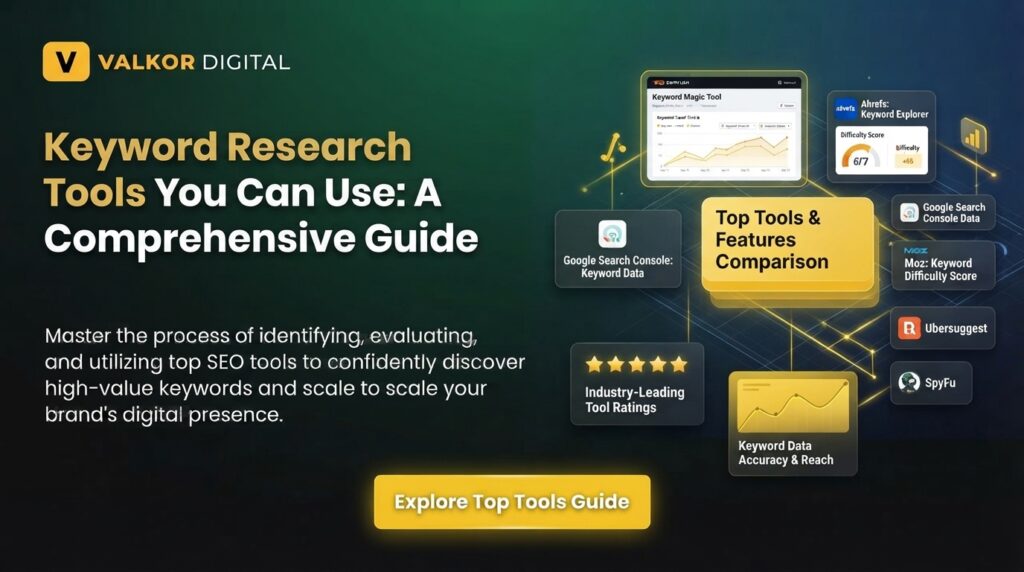
Once you have a list of initial ideas, use reliable data to evaluate them. Several keyword research tools can help you identify search demand, related queries, competition, and potential opportunities.
Google Keyword Planner
Google Keyword Planner can provide keyword ideas and search-volume estimates. It is particularly useful for discovering variations and related terms around your core topics.
Google Search Console
If your website already receives organic traffic, Search Console can reveal the queries for which your pages are appearing.
Google specifically recommends checking the Performance report and its queries data for terms that users search before visiting your website.
These existing queries can uncover opportunities that traditional research may overlook.
Google Trends
Google Trends can help you understand whether interest in a topic is increasing, declining, or seasonal. It can also help compare related terms and identify emerging topics.
SEO Platforms
Professional SEO platforms can provide additional information such as estimated search volume, keyword difficulty, competitor rankings, related queries, and SERP analysis.
The tool itself is not the strategy. The value comes from interpreting the data and selecting terms that make sense for your business.
Evaluate Search Volume and Competition
Search volume is useful, but it should not be the only factor in your decision.
A keyword with extremely high volume may also have intense competition from established websites. A more specific keyword with moderate search demand may offer a better opportunity for a growing business.
Consider:
- Search volume
- Keyword difficulty
- Search intent
- Business relevance
- Competition
- Conversion potential
- Current rankings
- Content quality in the SERPs
For example, a local business may benefit more from a location-specific service query than from competing immediately for a broad national keyword.
Create a Keyword Strategy
After collecting and evaluating potential terms, organize them into a clear keyword strategy.
Group related terms according to their topic and intent rather than creating a separate page for every minor variation.
For example:
Main topic: SEO services
Related topics:
- local SEO services
- technical SEO
- ecommerce SEO
- SEO for small businesses
- SEO agency services
A single comprehensive page may address closely related searches when the intent is similar. Separate pages may be more appropriate when the search intent or audience differs significantly.
This approach also helps prevent keyword cannibalization, where multiple pages compete for the same search query.
Where Should You Use Your Target Keywords?
Once you have selected your target terms, incorporate them naturally into relevant parts of your website.
Important areas include:
Page Titles
Your primary topic should be clearly represented in the title while keeping it appealing to users.
Headings
Use relevant terms in H1, H2, and H3 headings where they accurately describe the section.
Main Content
Discuss the topic comprehensively rather than repeatedly inserting the same phrase. Related terminology and naturally occurring language can help demonstrate topical depth.
URLs
Keep URLs short, descriptive, and relevant to the page topic.
Meta Descriptions
A compelling meta description can communicate what users can expect from the page and encourage clicks from search results.
Internal Links
Internal linking helps users navigate your website and helps search engines understand relationships between pages.
For businesses looking to improve how their pages are structured and optimized, Valkor Digital also provides on-page SEO services designed to strengthen important on-page elements and improve search visibility.
Common Keyword Research Mistakes to Avoid
Even a well-planned SEO campaign can lose effectiveness when keyword selection is handled incorrectly.
Choosing Keywords Based Only on Search Volume
High volume does not automatically mean high value. Always consider relevance and intent.
Targeting Extremely Broad Terms
Broad keywords can be difficult to rank for and may attract users who are not interested in your specific offering.
Ignoring Search Intent
If the search results primarily show informational articles and you publish a sales page, your content may struggle to satisfy the intent behind the query.
Stuffing Keywords Into Content
Repeating a phrase excessively can make content difficult to read and provide a poor user experience. Write naturally and prioritize useful information.
Focusing Only on One Keyword
A page can rank for many related queries. Build comprehensive content around a topic instead of forcing one exact phrase into every paragraph.
How Often Should You Review Your Keywords?
Keyword research should not be treated as a one-time task.
Search behavior changes, competitors publish new content, new products enter markets, and customer interests evolve. Regularly reviewing Search Console data, trends, rankings, and competitor activity can reveal new opportunities.
Google Trends can also help identify changing search interest and emerging topics that may deserve attention.
For established websites, reviewing performance regularly can help identify pages that are gaining impressions but need better optimization to increase clicks and conversions.
Final Thoughts
Successful SEO starts with understanding what your audience wants to find. The right search terms provide direction for your content, landing pages, internal links, and broader optimization efforts.
Rather than chasing every high-volume query, focus on terms that align with your products, services, audience, and business objectives. Combine search intent with competition analysis and performance data to identify realistic opportunities.
When keyword selection is connected to valuable content and strong on-page optimization, it becomes more than a ranking exercise—it becomes a practical way to attract qualified visitors and support long-term business growth.
Frequently Asked Questions
1. What is keyword research in SEO?
Keyword research is the process of identifying search terms that people use on search engines and evaluating their relevance, intent, competition, and potential value for a website.
2. How do I choose the right keywords?
Choose keywords that closely relate to your products or services, match your audience’s search intent, have realistic competition, and can contribute to your business goals.
3. Which keyword tool is best for beginners?
Google Keyword Planner, Google Search Console, and Google Trends are useful starting points. More advanced SEO platforms can provide additional competitive and keyword data.
4. How many keywords should I target on one page?
There is no fixed number. Focus on one main topic and naturally cover closely related terms and questions rather than targeting an arbitrary keyword count.
5. Should I update my keyword research?
Yes. Search behavior and competition can change over time. Reviewing performance data and emerging search trends regularly can help you identify new opportunities and keep your SEO strategy relevant.