I. The App Download Problem Nobody Talks About
Here is a scenario that plays out thousands of times a day across Pakistan. A potential customer discovers your brand — through an Instagram ad, a WhatsApp forward, or a Google result. They are interested. They click through. They are on your mobile site, browsing your products, building intent. Then you hit them with the ask: ‘Download our app for the best experience.’
And most of them leave.
Not because your product is wrong. Not because your price is off. Because you asked them to interrupt their journey, open the App Store or Google Play, search for your app among millions of others, wait for a 100MB download on a mobile connection, create an account, verify their email, log in, and then — finally — continue the shopping experience they were already in the middle of on your website.
In markets with high smartphone penetration and high disposable income, that friction is tolerable. In Pakistan’s mobile market — where storage is at a premium, data plans are budgeted carefully, and app discovery is dominated by entertainment rather than commerce — it is a conversion killer. Industry data consistently shows that the average Pakistani mobile user has fewer than 25 apps installed and actively uses fewer than 10. New apps are added only when the value proposition is compelling enough to justify the storage cost and the download friction.
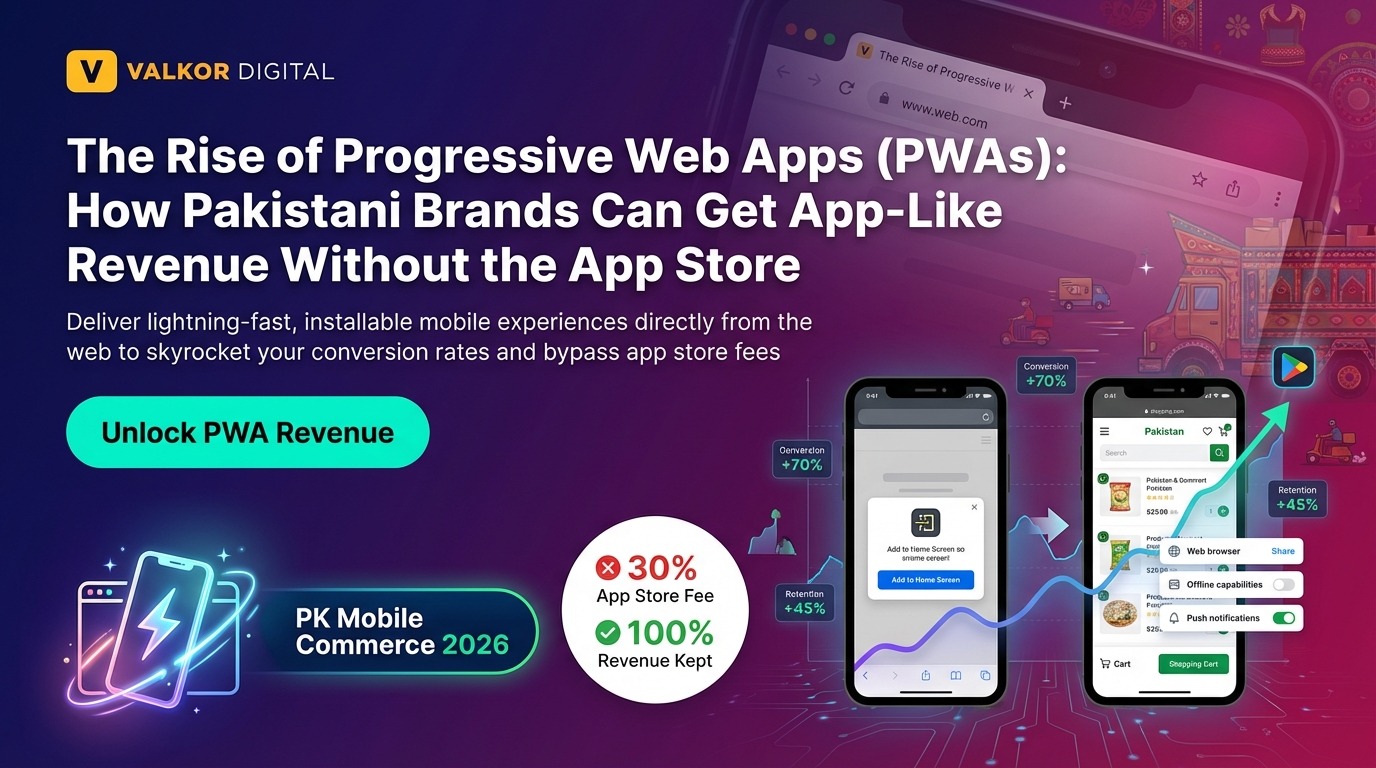
Progressive Web Apps exist specifically to solve this problem. They deliver every meaningful revenue feature of a native app — home screen presence, push notifications, offline functionality, instant load times, full-screen experience — without asking your customer to visit a store, wait for a download, or give up 100MB of precious phone storage.
And they do it at a fraction of the development cost.
| Global brands that made the switch to PWA and saw immediate results: AliExpress saw a 104% increase in new user conversion rates after launching its PWA. Twitter’s PWA reduced data consumption by 70% while tripling session length. Forbes saw a 100% increase in engagement after rebuilding as a PWA. These are not experimental results from small brands they are documented outcomes from some of the world’s highest-traffic digital products. The technology that produced these results is now available to any Pakistani brand that chooses to build on it at a development cost well within reach of a growing SME. |
II. What Exactly Is a Progressive Web App?
A Progressive Web App is a website that has been engineered to behave exactly like a native mobile application — but runs entirely in the browser, installs from the browser, and updates through the browser, without the App Store as an intermediary.
The user experience from the customer’s perspective: they visit your URL on their smartphone’s browser. A prompt appears at the bottom of the screen: ‘Add Valkor Store to Home Screen.’ They tap it. An icon appears on their home screen, indistinguishable from any other app icon. The next time they tap that icon, the experience opens in full screen, with no browser address bar, no navigation chrome — just your brand, full screen, app-like. And it loads in under a second because the core interface was cached to their device at first visit.
Three core web technologies make this work:
Service Workers
Background scripts that intercept network requests and serve cached versions of pages, assets, and data. This is the technology that enables offline browsing and instant load times the browser stores a ‘snapshot’ of your site so the user sees content immediately, even before the network responds.
Web App Manifest
A JSON configuration file that tells the browser how your PWA should look and behave when installed on a home screen. It defines the app name, icon, splash screen, theme colour, and display mode creating the full-screen, chrome-free experience that makes a PWA indistinguishable from a native app once launched.
Push Notification API
The Web Push API allows your PWA to send notifications directly to a user’s device lock screen even when their browser is closed and they are not actively using your site. No native app. No App Store. No permission from Apple or Google to reach your customer’s phone directly.
The combination of these three technologies
Service Workers for performance and offline capability, the Web App Manifest for native look and feel, and the Web Push API for direct user re-engagement is what makes a PWA genuinely competitive with a native app for most Pakistani e-commerce and service business use cases.
III. Why PWAs Are the Perfect Technology for the Pakistani Market
The global case for PWAs is well-documented. The Pakistani case is more specific, more urgent, and almost entirely unexplored in existing guides written for international markets. Here is why the four core PWA advantages map directly onto the four biggest constraints in Pakistan’s mobile commerce landscape:
The Phone Storage Crisis
Pakistan’s mobile market is dominated by budget and mid-range Android devices Tecno, Infinix, Xiaomi with 32 to 64GB of internal storage, much of it already consumed by WhatsApp media, family photos, and existing apps. A native Android app averages 50 to 150MB. A PWA averages 1 to 3MB. That difference 50x to 100x lighter is the difference between an install and an immediate dismissal.
Patchy 3G/4G Networks
Network stability in Pakistan is highly variable not just in rural areas, but in busy urban environments during peak hours in Karachi, Lahore, and Islamabad. Service Workers cache your product catalogue, pricing, and cart state locally. A customer browsing your store in a lift, an underground market, or on a congested mobile network can continue shopping and add items to their cart completely offline the order syncs when connectivity resumes.
Bypassing the App Store
Apple’s App Store review process takes 1 to 7 days per submission. Google Play averages 3 to 7 days. Both impose strict content and functionality guidelines that can reject or delay a launch. Both charge a 15 to 30% commission on in-app purchases. A PWA bypasses all of this entirely: no review, no approval, no commission, no waiting. You push an update to your server every user on every device sees it instantly, the next time they open the app.
SEO Discoverability
This is the dimension where PWAs fundamentally outperform native apps as a business asset. Google indexes PWA content exactly like a website every product page, every category, every blog post is crawlable and rankable in organic search. A native app’s content is invisible to Google Search. A competitor with a PWA is building compounding organic traffic; a competitor with only a native app is entirely dependent on app store discovery or paid acquisition.
The convergence of these four factors — storage constraints, network instability, App Store friction, and SEO requirements — makes Pakistan one of the markets where the PWA advantage over native app development is most pronounced. A Pakistani brand choosing between a PKR 5 to 8 million native app build and a PWA that costs 50 to 70% less, deploys faster, and generates organic search traffic is not making a compromise — it is making the strategically superior decision for its market.
IV. The Direct Revenue Impact: Why PWAs Convert Better
The technical elegance of PWAs is interesting. The revenue impact is what matters to a business owner. These three numbers summarise the commercial case:
| 50–70% increase in mobile conversion rate for brands migrating to PWA | 3× lower cost per install compared to promoting a native app download | 68% of cart abandonment push notifications are opened within 1 hour of delivery |
The Push Notification Revenue Engine
This is the PWA feature that most directly translates to measurable, attributable revenue — and it is the feature that surprises most Pakistani business owners who have been told that push notifications require a native app.
Web Push Notifications, delivered through the PWA’s Push API, allow you to send messages directly to a user’s device lock screen at any time — even when their browser is closed, even when your PWA is not running in the background. The opt-in rate for web push notifications is typically higher than email list sign-ups because the friction is lower: a single ‘Allow’ tap, versus an email address, a confirmation email, and a verify link.
The specific revenue use cases for Pakistani e-commerce brands are direct:
- Abandoned cart recovery: Abandoned cart recovery: A user adds three items to their cart and closes the browser without checking out. Twenty minutes later, a push notification arrives on their lock screen: ‘Your cart is waiting — complete your order before stock runs out.’ Conversion rates on abandoned cart push notifications consistently outperform email recovery sequences.
- Flash sales: Flash sale announcements: A time-limited sale goes live. Every user who has opted in to push notifications receives a lock screen alert simultaneously — without requiring them to open your app, check your Instagram, or see a WhatsApp broadcast. The immediacy drives urgency-based conversions that scheduled email campaigns cannot replicate.
- Back-in-stock: Back-in-stock alerts: A high-demand product was sold out. The customer added their number to a waiting list. When stock is replenished, a push notification goes out instantly — catching buyers at the moment of maximum intent rather than waiting for them to remember to re-check your website.
- Re-engagement: Personalised re-engagement: Users who have not visited in 14 days receive a personalised notification based on their last browsed category. Behavioural re-engagement through push typically generates 3 to 5× higher conversion rates than generic broadcast messages.
Instant Load Times — and the CWV Connection
If you read the first article in this series on Core Web Vitals, you will recognise the connection immediately: PWAs are structurally engineered to pass LCP, INP, and CLS benchmarks with significantly less effort than a traditional website.
The Service Worker caches the application shell — the navigation, the header, the structural layout — on first visit. Every subsequent page load serves the cached shell instantly, then fetches only the data (product information, pricing, inventory) from the server. The user perceives near-instant page transitions because the visual structure appears in milliseconds, even before the data arrives. This is why PWA-powered sites consistently report LCP scores well under the 2.5-second threshold even on mid-range devices with mobile connections.
For Pakistani e-commerce stores where the average customer device and network conditions present significant performance challenges, this architectural advantage translates directly into lower bounce rates, longer session durations, and higher conversion rates — exactly the outcomes that justify the investment.
V. PWA vs. Native App: The 2026 Cost and Capability Breakdown
The table below is designed to give business owners a clear, honest comparison of every meaningful dimension. The goal is not to make native apps look bad — for certain use cases, particularly complex consumer applications with heavy device integration requirements, native development remains the right answer. But for the vast majority of Pakistani e-commerce brands, service businesses, and local retailers, the comparison makes the business case for PWA decisively:
| Dimension | ✅ Progressive Web App (PWA) | 📱 Native Mobile App (iOS + Android) |
| Development Cost | 50–70% lower. Single codebase serves web, iOS, and Android simultaneously. One development team, one codebase, one deployment pipeline. | High and compounding. Requires separate specialist developers for iOS (Swift) and Android (Kotlin/Java). Two codebases to maintain indefinitely. |
| Time to Launch | Weeks. A PWA is built on web technologies and deploys like a website. No store submission, no approval waiting period. | Months. Development, QA, App Store submission, review process, and approval typically take 3 to 6 months for a production-ready v1.0. |
| User Acquisition Friction | Near zero. User visits your website in any browser, taps ‘Add to Home Screen,’ and the icon appears. No search, no download, no sign-up required. | High. User must open App Store or Google Play, search for your app, read reviews, tap install, wait for the download, and create an account. |
| File Size on Device | 1 to 5MB. The PWA shell is cached locally; only the data updates are fetched dynamically from the server. | 50 to 200MB or more. Full native app binaries, assets, and runtime must be downloaded and stored locally. |
| SEO Discoverability | Full Google indexing. Every page, product, and blog post within your PWA is crawlable and rankable in organic search — exactly like a standard website. | Zero organic search visibility. App store content is not indexed by Google. Discovery depends entirely on paid acquisition or word of mouth. |
| Push Notifications | Web Push API delivers notifications to the device lock screen — even when the browser is closed — on Android and (with some limitations) iOS 16+. | Full native push notification support on both platforms, typically with slightly higher open rates than web push on iOS devices. |
| Offline Functionality | Service Workers cache the application shell and selected content. Users can browse cached product pages and add to cart without an active connection. | Full offline capability, including access to locally stored account data, order history, and cached content. |
| App Store Fees & Rules | None. No commission on purchases processed through the PWA. No approval required for updates or new features. | 15 to 30% commission on all in-app purchases. All updates subject to App Store review. Apple can reject or remove your app at any time. |
| Updates | Instant. Push an update to your server — every user worldwide sees the new version the next time they open the PWA. No user action required. | Manual. Users must update via the App Store. A significant percentage of your user base will be running outdated versions at any given time. |
The row that most Pakistani business owners find most clarifying is the App Store fees row. A native iOS app processing in-app purchases surrenders 15 to 30% of every transaction to Apple. A PWA processing the same purchases through your own payment gateway pays only the standard gateway processing fee — typically 1.5 to 2.5%. On a store doing ten million rupees per month in revenue, the difference is substantial enough to fund the entire PWA development cost within a single month of operation.
When does a native app still make sense?
Native development remains the right choice for applications that require deep device hardware access camera APIs, biometric authentication, Bluetooth, ARKit/ARCore for augmented reality, or complex real-time interactions that push against what the browser can deliver.
Ride-sharing apps, health monitoring applications, and enterprise tools with complex offline data synchronisation are typically better served by native development. For a Pakistani clothing brand, a furniture retailer, a restaurant chain, a services agency, or a local product marketplace a PWA will outperform a native app on every commercially relevant metric, at a fraction of the cost.
VI. Conclusion: The App Store Era Is Over for Most Pakistani Brands
The mental model that a ‘proper’ mobile commerce presence requires a native iOS and Android app is a legacy of an era when PWA technology was immature and web browsers could not reliably deliver offline functionality, push notifications, or app-like user experiences. That era ended several years ago. In 2026, the browser is capable of delivering every commercially meaningful feature that drives mobile commerce revenue — without the six-month development timeline, the $10,000 to $30,000 build cost, or the 30% App Store commission.
For Pakistani brands specifically, the case is even stronger. Your customers are on budget Android devices with limited storage, on variable mobile networks, in an environment where app download friction is high and app retention is low. PWA architecture addresses every single one of those constraints directly — while generating organic search traffic that a native app cannot touch.
The question is no longer whether PWA is a viable alternative to native app development for Pakistani e-commerce and service brands. It is whether your business will adopt it before your competitors do.
At Valkor Digital, our full-stack engineering team doesn’t just build websites.
We build scalable Progressive Web Apps — engineered for Pakistan’s mobile market, integrated with local payment systems, and built to pass Google’s Core Web Vitals from day one.
→ Book a Free PWA Strategy Session Today ←
⚠️ Up Next — and You Need to Read This One: Security Audits 2026: Is Your Business Website a Ticking Time Bomb?
You’ve built the fast site, chosen the right platform, and launched the PWA. Now cyber attacks on Pakistani businesses are at an all-time high and a single breach can destroy everything you’ve built. Find out exactly how exposed you are, and what to do about it, in the final guide of our Web Dev series.