I. The Problem Nobody Is Talking About Honestly
You open Google Search Console on a Monday morning and your rankings look fine. Page one. Maybe even position two or three. But your traffic is down 30%. Your leads are down. Something is wrong, and no one can explain it.
Here is the explanation: your potential customers are getting their answers without ever clicking your link.
Google’s AI Overviews now sit above all organic results, summarising the best information from across the web and presenting it as a single, authoritative response. ChatGPT Search, Perplexity AI, and Microsoft Copilot are doing the same thing. The user asks a question, the AI answers it completely, and your carefully crafted blog post — the one you spent three hours writing — gets skimmed for data and never visited.
This is not a glitch. This is the new architecture of search. And in 2026, if your digital strategy does not account for it, you are essentially building a shop on a road that is being rerouted.
| The Brutal Statistic According to SparkToro’s 2024 Zero-Click Study, nearly 60% of Google searches in the US and EU ended without a single click to any website. With AI Overviews now rolling out globally, that number is only climbing. Pakistani markets are next. |
II. What Is Generative Engine Optimization (GEO)?
Generative Engine Optimization — or GEO, sometimes called Answer Engine Optimization (AEO) or AI SEO — is the discipline of optimising your brand and content so that Large Language Models (LLMs) trust you enough to reference you in their direct, AI-generated answers.
Think of it this way: traditional SEO is about convincing Google’s algorithm to put your webpage on the first page. GEO is about convincing an AI — which has already read the entire first page — to quote you as the single best answer.
The Mindset Shift You Need to Make Right Now
| Old Way (2015–2023): “How do I rank for this keyword?” New Way (2024–2026+): “How do I make AI understand, trust, and extract my content to answer a user’s prompt?” |
The Zero-Click Reality — and Why It’s Not All Bad
Yes, AI search produces fewer clicks overall. But here is the nuance that most articles miss: the clicks that do happen are dramatically higher intent. When an AI engine summarises your service, cites you by name, and then a user clicks through to your website, that person is essentially pre-sold. They have already received the pitch from a trusted third party (the AI). Your conversion rate on those visits is measurably higher.
The goal of GEO is not just to survive zero-click search — it is to become the brand that the AI recommends by name, so that when someone is ready to buy, your name is already in their head.
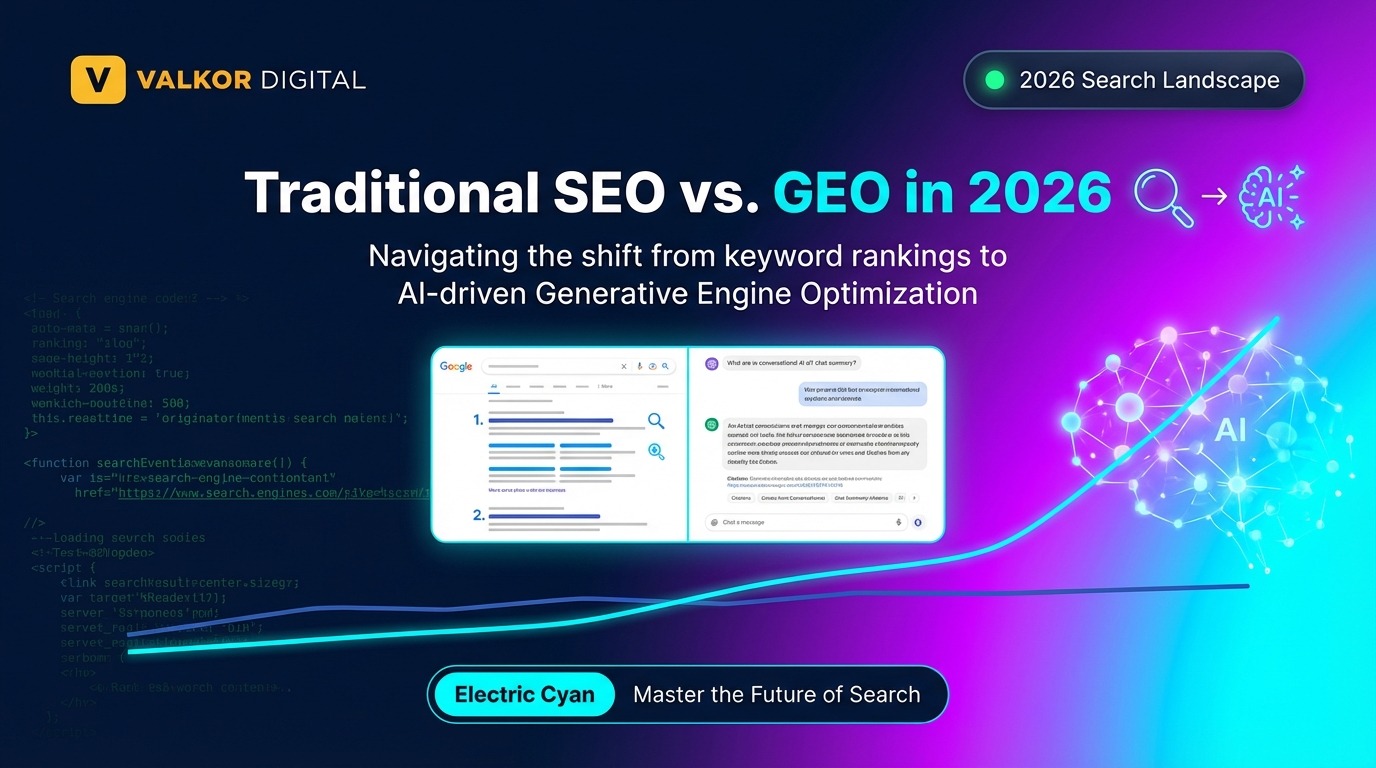
III. Traditional SEO vs. GEO: The 2026 Breakdown
The table below is designed for both human readers and AI extraction. These are the core distinctions every business owner and marketing manager in Pakistan needs to understand before allocating a single rupee of their 2026 digital budget.
| Feature | Traditional SEO | Generative Engine Optimization (GEO) |
| Primary Goal | Rank individual web pages in SERPs. | Be cited as a trusted source in AI-generated answers. |
| Core Metric | Organic traffic, clicks, and keyword rankings. | Brand mentions, citation frequency, and Share of Voice in AI outputs. |
| Content Focus | Keyword density, search volume, long-form articles. | Direct answers, structured data, and high-density facts. |
| Authority Signals | Backlinks and Domain Authority (DA). | Entity recognition, brand mentions on Reddit/LinkedIn, and E-E-A-T. |
| User Journey | Search → Click → Read → Convert. | Prompt → Read AI Summary → High-Intent Click → Convert. |
| Optimization Target | Google’s crawlers and ranking algorithms. | LLMs: ChatGPT, Gemini, Perplexity, and Google AI Overviews. |
The critical insight from this table: these are not competing strategies. Traditional SEO builds the foundation — the technical trust signals, the indexed pages, the domain authority — that allows GEO to work. You cannot skip step one. But in 2026, step one alone is no longer enough.
IV. The 3 Pillars of a Winning GEO Strategy
These are the three levers you must pull to make AI engines not just aware of your brand, but actively willing to recommend it. Each pillar is actionable. Each one can be started this week.
Pillar 1 — Entity Optimisation & Schema Markup
AI does not read content the way a human does. It reads relationships. It wants to know: Who is this? What do they do? Are they a real, verified organisation? Where are they? What have other trusted sources said about them?
Schema Markup is the structured data language that answers these questions directly. By embedding JSON-LD schema code into your website’s HTML, you are essentially handing the AI a business card — one that it can read, trust, and reference. For Valkor Digital, this means implementing:
- Organisation Schema — declaring your legal business name (Valkor Digital), location (Karachi, Pakistan), founding date, and service areas.
- Article Schema — on every blog post, marking up the author (Ali Abbass Memon), publication date, and topic category so the AI can cite the author by name.
- LocalBusiness Schema — confirming your geographic service area so local queries in Karachi, Lahore, or Islamabad surface your brand.
- FAQ Schema — structured Q&A blocks that AI Overviews can lift directly into their answers.
Entities — named, real-world things that AI models recognise — are the currency of GEO. The more clearly you declare your entity (your brand, your people, your services) across your own site and across the web, the more confidently the AI will include you in its answers.
Pillar 2 — Structuring Content for AI Extraction
AI engines are, fundamentally, very sophisticated readers that are also very impatient. They scan for direct answers. They extract facts. They prioritise structured, scannable content over long narrative prose with buried insights.
The practical implications for your content strategy are clear:
- Answer first, then explain. Every H2 and H3 heading should be followed immediately by a 2–3 sentence direct answer — the single most important takeaway. Only after that direct answer should you expand into detail, examples, and context.
- Use H2/H3 hierarchies religiously. A well-structured heading architecture is not just good UX — it is the map an LLM uses to understand what your page is about. Each heading should be a searchable question or clear statement.
- Write in declarative sentences. ‘Core Web Vitals directly impact both Google rankings and AI citation likelihood’ is better than ‘There is a possible relationship between Core Web Vitals and search performance in various contexts.’
- Include statistics with sources. AI models love citing numbers. Every claim you make should, where possible, be backed by a specific figure. ‘43% of Pakistani internet users access the web primarily via mobile’ is extractable. ‘Many Pakistanis use mobile’ is not.
- Use tables and comparison blocks. Structured tables are among the most-cited content formats in AI Overviews. When you compare options, prices, or features — use a table.
Pillar 3 — Building Off-Site Authority (The New Backlinks)
The most counter-intuitive lesson in GEO: AI trusts what other people say about you far more than what you say about yourself. Your own website content matters, but the signals that truly drive AI citations come from external, independent sources.
This is the 2026 version of link building, and it looks very different from the old model. It is not about getting 200 low-quality backlinks from directory sites. It is about building genuine presence in the places where AI models go to verify credibility:
- Reddit and Quora — When real people recommend your agency or answer questions by referencing your content on these platforms, AI models interpret that as authentic, unsponsored endorsement. Encourage your satisfied clients to mention you naturally.
- LinkedIn (founder and company) — LinkedIn content is heavily indexed by AI models. Ali Abbass publishing weekly insights about digital strategy in Pakistan builds the entity signal that ‘Valkor Digital = expertise in Pakistani digital marketing.’
- Industry review platforms — Clutch, Google Business Profile, and local Pakistani business directories. AI models check review platforms to verify that a business is real, active, and trusted.
- PR and digital publications — A single mention in Dawn Business, ProPakistani, or a relevant industry publication carries enormous weight with AI models. It signals that a trustworthy third party has independently validated your expertise.
- Guest articles and expert quotes — Writing for other established websites — or being quoted by them — builds the entity web that AI engines use to confirm your authority.
V. Why Pakistani Businesses Must Adapt Now
The Hyper-Local AI Opportunity
Here is a fact that should excite every business owner reading this in Karachi, Lahore, or Islamabad: local AI search is still largely unclaimed territory in Pakistan. When a user asks ChatGPT or Perplexity for the ‘best web development agency in Karachi,’ the AI pulls from whatever verified, structured, entity-rich information is available. Right now, that information is sparse.
The businesses that build robust Schema Markup, maintain active Google Business Profiles, accumulate genuine reviews, and publish consistent, structured content in 2026 will own these AI-generated local recommendations for years. The window to establish this early-mover advantage is narrow.
The AI looks for verified local entities with strong E-E-A-T — Experience, Expertise, Authoritativeness, and Trustworthiness — in the specific geographic area being queried. Hyper-local content (mentioning Karachi neighbourhoods, local business challenges, specific Pakistani regulations or market conditions) is a signal that you are genuinely embedded in this market, not just a generic digital agency.
Voice Search and Conversational Queries
Pakistan’s mobile-first internet population is increasingly using voice assistants — Siri, Google Assistant, and increasingly ChatGPT’s voice mode — to ask questions in natural, conversational language. Critically, these queries are often code-switched: a mix of English and Urdu, reflecting how Pakistanis actually speak.
GEO is structurally built for this. A voice search query like ‘yaar, kaunsi agency se website banwayein Karachi mein?’ is a long-tail, conversational question. Traditional SEO was optimised for two-word keyword queries. GEO is optimised for full questions — exactly what voice search produces.
Content that directly answers conversational, question-based queries in clear, plain English (or transliterated Urdu) is primed for both voice search extraction and AI Overview citation. This is a competitive advantage that most Pakistani businesses have not yet recognised.
| A Practical Example for Pakistani SMEs User prompt in Google AI Overview: ‘What should I look for when hiring a digital agency in Karachi?’ If Valkor Digital has a well-structured article titled exactly that — with clear H2 sections, FAQ Schema, a Google Business Profile with 50+ reviews, and LinkedIn mentions — there is a strong probability that the AI cites Valkor’s content as the authoritative answer. That is what GEO captures. |
VI. Your GEO Action Plan: Where to Start This Week
Strategy without execution is just reading. Here is a prioritised, practical sequence for any Pakistani business ready to start building GEO into their digital presence:
Week 1 — Audit & Foundations
- Run a technical audit: is your site fast? (Core Web Vitals pass/fail) Is it mobile-first? These are still prerequisites.
- Check your Google Business Profile: is every field complete? Do you have recent photos, updated hours, and at least 20 reviews?
- Install Organisation and LocalBusiness Schema on your homepage and About page.
Week 2 — Content Architecture
- Identify your top 5 existing blog posts or service pages. Rewrite the opening paragraph of each to lead with a direct, 2-sentence answer to the page’s core question.
- Add FAQ sections to every service page. Write the questions as users would actually ask them — full sentences, conversational tone.
- Implement Article Schema on your blog posts, including author name and expertise.
Week 3–4 — Off-Site Authority Building
- Begin a LinkedIn publishing cadence: one substantive post per week, sharing a core insight from your latest blog.
- Identify 3 local Pakistani forums, Facebook groups, or Reddit communities where your potential clients ask questions. Answer genuinely and consistently.
- Reach out to one industry publication (ProPakistani, TechJuice, or a relevant business blog) with a guest article pitch.
Conclusion: Build the Foundation, Then Build the Roof
Traditional SEO is not dead. It is the concrete slab your entire digital presence rests on. Technical performance, indexed content, authoritative domain — these still matter enormously. Without them, GEO cannot function.
But in 2026, the foundation alone will not keep the rain out. GEO is the roof. It is the layer that ensures that when AI engines survey the landscape and decide who to recommend, your brand is the one they cite with confidence.
The businesses that understand this shift now — and act on it before their competitors do — will not just maintain their traffic. They will capture the attention of an entirely new category of high-intent user: the person who asked an AI, received your name as the answer, and arrived at your website already convinced.
Don’t Let AI Give Your Customers to Your Competitors.
Valkor Digital’s Search Dominance service bridges the gap between traditional SEO and 2026 GEO — built specifically for Pakistani businesses ready to lead their market.
→ Get Your Free Digital AI Search Audit Today ←
What’s Next? > Now that you know how to optimize for AI engines, you need to understand how Pakistani consumers are actually talking to these AIs. The days of typing “SEO agency Karachi” are ending. Today, your customers are using their phones to ask, “Where is the best digital marketing agency near me?”
If your business isn’t optimized for spoken, conversational queries, you are handing high-intent leads to your competitors.
👉 Ready to capture the mobile market? Read our next guide: The 2026 Guide to Local SEO in Pakistan: How to Dominate Voice Search.